He Had Headaches for 6 Months. A Brain Scan Revealed Glioblastoma.
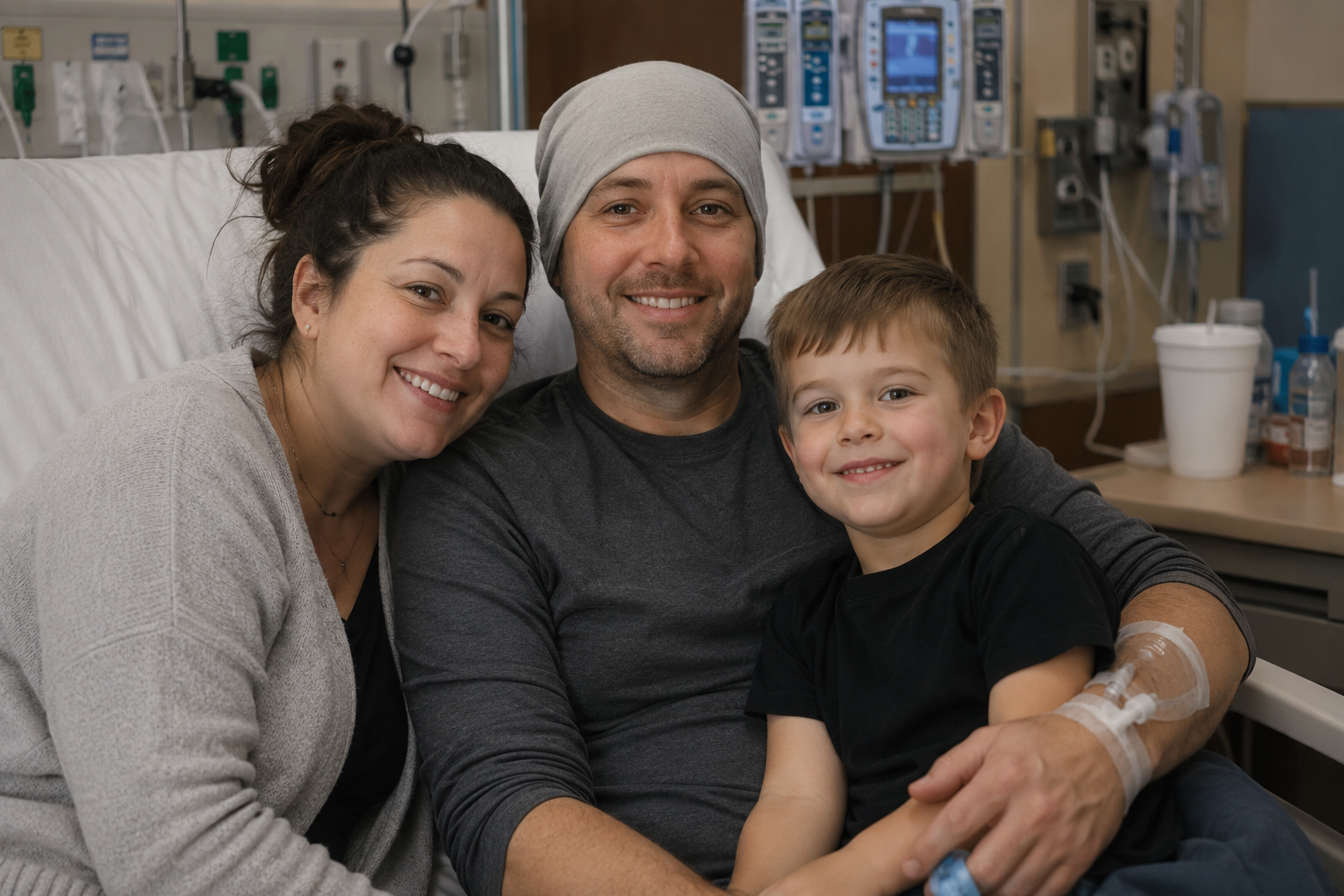
James Carter thought he needed glasses.
The headaches had started in February — dull, persistent pressure behind his right eye that he blamed on screen time. He was a software engineer who spent ten hours a day staring at monitors, and the logical explanation was always the simplest one. He ordered blue-light glasses online. He bought a new pillow. He downloaded a sleep tracking app.
By April, the headaches were waking him up at 3am.
By May, he had his first seizure. He was standing in his kitchen making coffee when his legs gave out. His wife, Karen, found him on the floor, conscious but confused, unable to say his own name for nearly four minutes.
The emergency room ran a CT scan the same evening.
The radiologist called it one of the largest glioblastomas he had seen in a patient under 40.
The Diagnosis Nobody Is Prepared For
Glioblastoma multiforme — GBM — is the most aggressive form of primary brain cancer. It grows fast, it infiltrates surrounding brain tissue, and it does not respond to treatment the way other cancers do. The standard treatment protocol has not changed significantly in nearly two decades: surgery to remove as much of the tumor as possible, followed by concurrent radiation and chemotherapy, followed by additional cycles of chemotherapy.
The median survival time after diagnosis is 14 to 16 months.
James was 38 years old. He and Karen had been married for six years. Their son, Oliver, had just turned four.
“The neuro-oncologist told us the statistics,” Karen says. “And then she told us that statistics describe populations, not individuals. That some patients respond well and live significantly longer. She wanted us to hold onto that.” She pauses. “We’re holding onto that.”
James had surgery eleven days after his seizure. The neurosurgeon achieved what is called a gross total resection — removing approximately 95 percent of the visible tumor mass. The remaining five percent was located too close to the motor cortex to safely remove without causing permanent paralysis to his left side.
He woke up from surgery able to move all four limbs. He wept with relief. So did everyone in the room.
The Long Road of Treatment
James began the Stupp protocol — the standard first-line treatment for glioblastoma — three weeks after surgery. This meant six weeks of daily radiation to his brain, five days a week, combined with daily oral chemotherapy. Then a four-week break. Then six additional cycles of chemotherapy, each lasting five days out of every twenty-eight.
The side effects accumulated over time. Fatigue that he describes not as tiredness but as a heaviness in his entire body, as if gravity had been turned up. Cognitive changes — finding words more slowly, losing his place in conversations, struggling with the complex problem-solving that had defined his career. Hair loss across the radiation field, leaving a patch above his right ear where nothing has grown back.
“The hardest part wasn’t the physical stuff,” James says. He is sitting at the kitchen table where he had his seizure eight months ago, Oliver’s drawings spread across one end. “The hardest part was telling Oliver that Daddy was sick. That Daddy’s brain had something in it that the doctors were trying to fix. He’s four. He understood enough to be scared and not enough to understand why.”
Oliver now draws pictures of his father at the hospital. In the drawings, James always has a big smile. Oliver always draws a heart next to him.
James has completed four of his six chemotherapy cycles. His most recent MRI showed no evidence of tumor recurrence at the surgical site — a result his oncologist described as “very encouraging.”
It is not a cure. Glioblastoma almost always returns. But it is time — more time with Karen, more mornings with Oliver, more ordinary moments that have become extraordinary simply by virtue of still happening.
The Financial Weight of Surviving
James has not been able to work since his diagnosis. The cognitive effects of his treatment — the slowness of thought, the difficulty concentrating — make the focused, detail-oriented work of software engineering impossible for now. His company has been generous with short-term disability payments, but those are capped at 60 percent of his salary and will expire at the one-year mark.
Karen works as a nurse. She has reduced her hours to be home more, which she does not regret for a single moment, and which has cost them approximately $800 a month in lost income.
The out-of-pocket medical costs in the first eight months have exceeded $28,000. This includes the surgical deductible, the neurosurgery follow-up appointments, the MRI scans every eight weeks at $400 per scan after insurance, the anti-seizure medication James takes daily, the steroids he needed during radiation, and the parking at the cancer center — $18 a day, four days a week, for six weeks of radiation.
“Nobody tells you about the parking,” Karen says, with the kind of laugh that sits right next to tears. “Nobody puts that in the brochure.”
They have used their emergency savings. They have b
Help James by sharing this story
Sharing costs nothing and could bring James the support they need.

Be the first to leave a message
Share a word of support, encouragement, or solidarity below.