Doctors Said It Was Stress. It Was Stage 4 Ovarian Cancer. Diana’s Story.
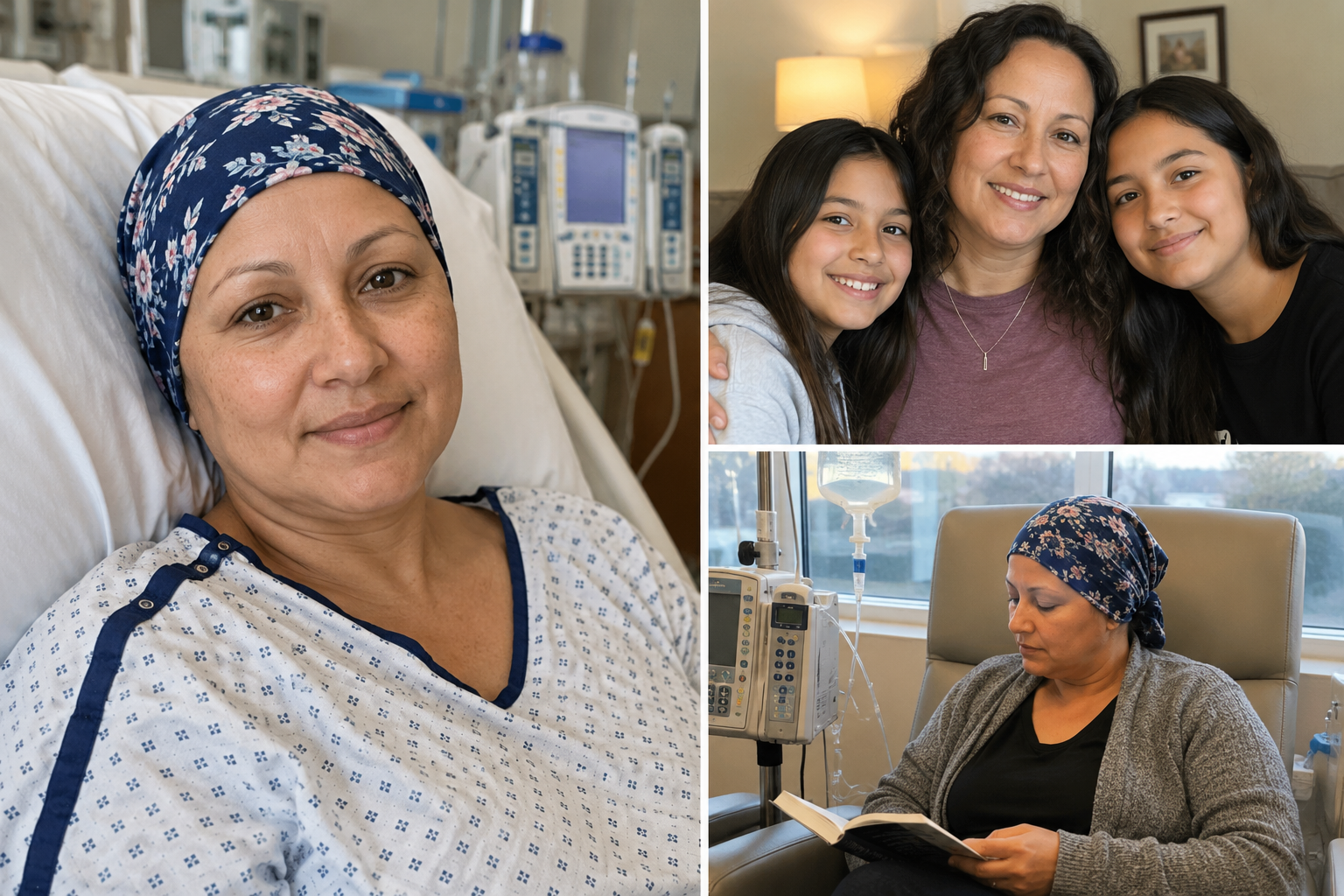
Diana Reyes had been telling her doctors something was wrong for eleven months.
The bloating started first — a persistent, uncomfortable fullness that no amount of dietary changes seemed to touch. Then came the fatigue, the kind that sat on her chest like something physical, making it hard to get through a workday without wanting to close her office door and lie down on the floor. Then the pain, dull and intermittent at first, low in her abdomen, easy to dismiss.
She is a high school Spanish teacher in Phoenix, Arizona. She is organized, articulate, and not prone to exaggeration. She kept a written log of her symptoms and brought it to every appointment.
Three different doctors told her it was stress.
“One of them looked at my list and said, ‘Diana, you’re a working mother of two. Of course your body is under strain,'” she says. “He wasn’t unkind about it. He just wasn’t listening.”
In month eleven, a fourth doctor — a new OB-GYN she switched to after moving her insurance — ordered a transvaginal ultrasound as part of a routine examination. She called Diana two days later and asked her to come in immediately.
The tumor was 9 centimeters. It had been growing quietly for what the oncologist estimated was at least fourteen months. It had already spread to her lymph nodes and the lining of her abdomen.
Stage 4 ovarian cancer. Diana was 41 years old.
The Diagnosis That Rewrites Everything
Ovarian cancer is often called the silent killer — not because it produces no symptoms, but because its symptoms are so easily attributed to other causes. Bloating. Fatigue. Pelvic discomfort. Back pain. Changes in appetite. These are the kinds of complaints that fill general practitioners’ offices every day, and they are the kinds of complaints that get filed under stress, IBS, or perimenopause in women in their thirties and forties.
Diana’s case was not exceptional. It was heartbreakingly common.
“When the oncologist told me the stage, I didn’t cry,” Diana says. “I just sat there doing the math. My daughters are twelve and nine. I was doing the math on whether I would be there when they graduated high school.”
Her husband, Carlos, was sitting next to her. He reached over and covered her hand with his. Neither of them spoke for a long moment.
“Then I asked the doctor what we were going to do,” Diana says. “Because that’s who I am. I needed a plan.”
The plan was aggressive. Six rounds of platinum-based chemotherapy, followed by debulking surgery to remove as much of the tumor mass as possible, followed by additional chemotherapy. Her oncologist was direct: Stage 4 ovarian cancer has a five-year survival rate of approximately 29 percent. Those numbers are a population average, he reminded her. Some patients do far better. The goal was to put her in that group.
What Treatment Does to a Life
Diana began chemotherapy eight days after her diagnosis.
The side effects were severe from the first cycle. She lost her hair by week three — something she had braced herself for, but which still arrived as a shock when she stood in the shower and watched it come away in her hands. The nausea was manageable with medication but never fully absent. The neuropathy — a tingling, burning sensation in her fingers and feet that is a common side effect of platinum-based chemotherapy — made it difficult to type, to write on the whiteboard, to button her daughters’ school uniforms in the morning.
She taught through the first two rounds of chemotherapy, taking Fridays off for infusions and returning to her classroom on Mondays looking, by her own description, like someone who had spent the weekend being taken apart and put back together in the wrong order.
“My students knew,” she says. “Kids always know. They were extraordinary. One of my senior boys organized a card drive. I still have every single card.”
After the third round, her body made the decision her pride had been resisting. She went on medical leave.
The financial impact was immediate and severe. Diana’s salary covered roughly 60 percent of the family’s income. With her on leave, Carlos — an electrician who runs his own small contracting business — took on every job he could find. He worked six days a week. He dropped the girls at school before 7am and picked them up after 6pm. He cooked dinner, managed the household, and sat with Diana through the nights when the side effects were worst.
“He has not complained once,” Diana says. “Not once. I keep waiting for it and it doesn’t come. He just keeps showing up.”
The medical bills arrived with the same relentless consistency as the chemo cycles. Her insurance covered the infusions, but the anti-nausea medications required separate prior authorizations. The compression gloves she needed for the neuropathy were classified as cosmetic. Two wigs — because one wore out — were not covered. The mileage to and from the cancer center, four days a week for months, added up to more than anyone had budgeted for.
By the end of the fourth chemotherapy cycle, the family had depleted their savings and taken a second mortgage on their home.
Where Diana Is Now
Diana completed all six rounds of chemotherapy. In January, she underwent debulking surgery — a five-hour procedure that removed the primary tumor mass, sections of her bowel, and her appendix. Her surgeon described the surgery as going as well as it possibly could have.
Her most recent CT scan showed no evidence of active disease in her lymph nodes. There are still peritoneal deposits — small areas of cancer on the lining of her abdomen — that her oncologist is monitoring closely. She is now in maintenance therapy, taking a targeted PARP inhibitor daily to suppress any remaining cancer cells.
She is back in her classroom two days a week. Her students made a banner that reads “Ms. Reyes is a Fighter” and hung it above her whiteboard without asking permission. She left it there.
Her twelve-year-old daughter asked her directly one evening whether she was going to die. Diana told her the truth: she did not know. But she told her that she was fighting as hard as she possibly could, that she had extraordinary doctors, and that she intended to be there for every important moment of their lives.
“I can’t promise her I’ll be at her wedding,” Diana says quietly. “I’d be lying if I promised her that. But I can promise her that I will do everything in my power to get there. And that will have to be enough.”
The financial recovery will take years. The medical bills continue to arrive. The maintenance therapy is not cheap. Diana is not yet back to full-time work, and the income gap has not closed.
Diana’s story is not finished. She is still writing it — one scan at a time, one school day at a time, one morning with her daughters at a time.
She asked us to share it because she knows there are other women out there logging their symptoms and being told it is stress. She wants them to push. To ask for the scan. To trust themselves.
“Your body is trying to tell you something. Don’t let anyone talk you out of listening to it.” — Diana Reyes
If Diana’s story moved you, please consider donating to her fund. Every dollar goes directly to her family — helping with ongoing treatment costs, the income gap, and the medical bills that serious illness leaves behind. Any amount helps. It all matters.
Help Diana by sharing this story
Sharing costs nothing and could bring Diana the support they need.

Be the first to leave a message
Share a word of support, encouragement, or solidarity below.