Bobby Was 41 When His Hand Wouldn’t Stop Shaking. It Was Early-Onset Parkinson’s.
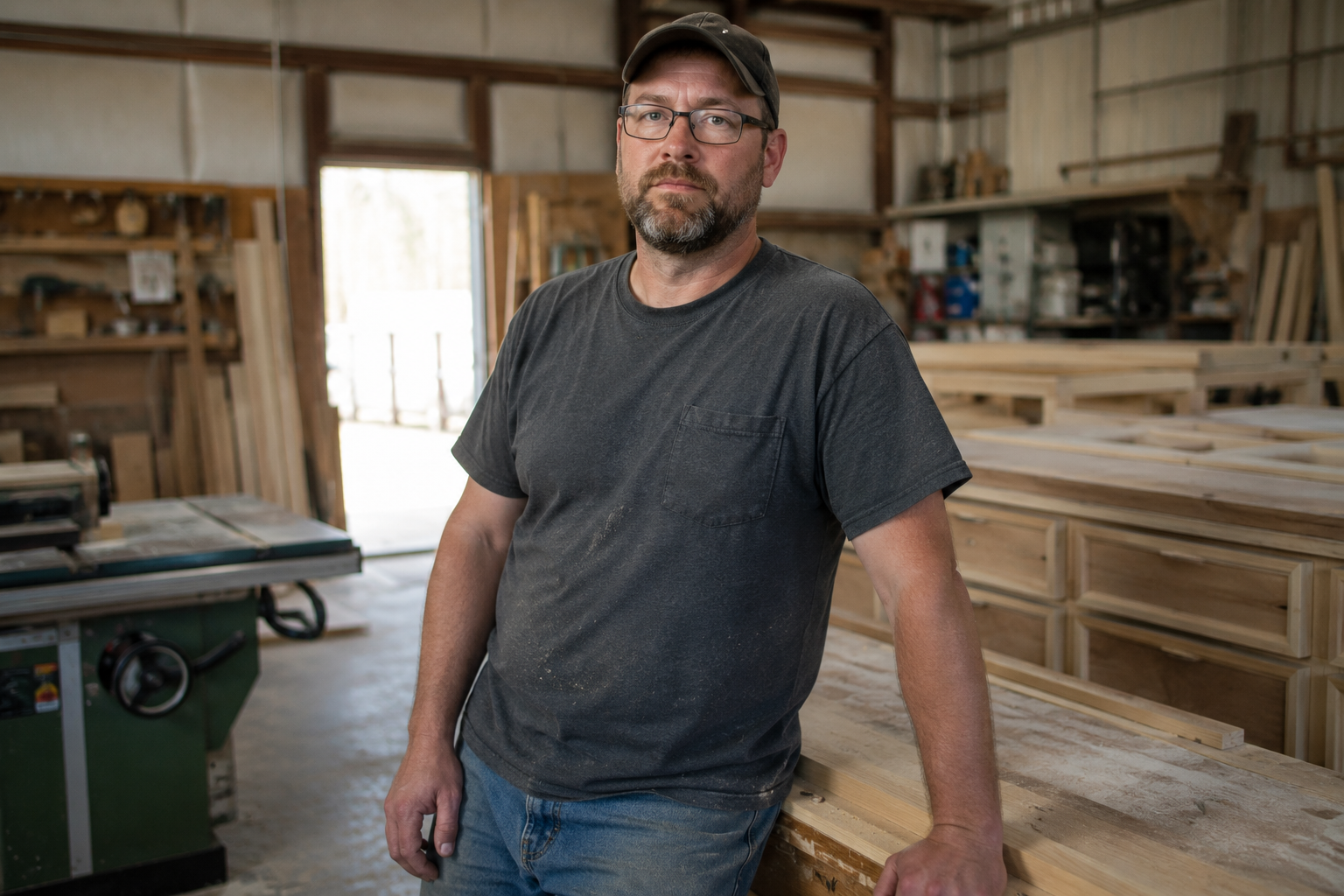
Bobby Malone noticed it first on a Tuesday morning in September, holding a coffee cup.
He was standing at the kitchen counter, the way he stood every morning, watching the news on the small TV above the refrigerator while his wife, Claire, made lunches for the kids. The coffee cup was trembling in his right hand — a fine, rhythmic tremor, barely visible, more felt than seen. He set the cup down and looked at his hand. The tremor continued for a moment and then stopped.
He picked the cup back up. It happened again.
He was a carpenter. His hands were his livelihood — the tools he used to measure, to cut, to fit and finish the custom cabinets and built-in shelving that had given his small business a reputation across three counties in western Pennsylvania. He had been using those hands skillfully since he was seventeen years old, working summers with his father. A trembling hand was not a small thing for Bobby Malone. It was, potentially, everything.
He told himself it was dehydration. He drank two glasses of water and went to work.
Over the following six weeks, the tremor became more consistent, appearing in his right hand during moments of rest — exactly the opposite of an essential tremor, which worsens with movement. He also noticed, in the quiet way you notice things you are hoping are not there, that his right arm had stopped swinging naturally when he walked. And that getting out of his truck in the morning took a beat longer than it used to, his body slow to initiate the movement in a way he could not explain.
Claire noticed the walk first. She did not say anything for two weeks because she did not want to frighten him. Then she said something.
“She sat down next to me one evening and said — Bobby, something is wrong, and we need to find out what it is,” he says. “That’s Claire. She doesn’t circle around things.” He pauses. “She was right. She’s usually right.”
His primary care doctor referred him to a neurologist. The neurologist examined him for forty-five minutes — watching him walk, observing his hand at rest and in motion, testing his reflexes, asking him to perform small precise movements that revealed, to a trained eye, a pattern that had a name.
Early-onset Parkinson’s disease. Bobby was 41 years old.
A Disease Most People Think Only Affects the Elderly
Parkinson’s disease is commonly understood as a condition of old age. The average age of diagnosis is 60, and most public awareness of the disease centers on elderly patients. What is less widely known is that approximately 10 to 20 percent of Parkinson’s diagnoses occur in people under 50 — a population referred to as early-onset or young-onset Parkinson’s patients.
Early-onset Parkinson’s presents particular challenges. Patients are typically still working, still raising children, still carrying the financial and practical responsibilities of mid-life. The disease does not pause for any of this. It progresses — slowly in most cases, but progressively — regardless of age, regardless of obligation, regardless of the fact that a 41-year-old carpenter in Pennsylvania still has decades of work ahead of him and two children who need their father to be able to do the things fathers do.
Parkinson’s is caused by the death of dopamine-producing neurons in a part of the brain called the substantia nigra. Dopamine is the chemical messenger that allows smooth, coordinated movement. As dopamine-producing cells die, movement becomes increasingly difficult to initiate and control. The hallmark symptoms — tremor, rigidity, slowness of movement, and impaired balance — result from this progressive dopamine depletion.
There is currently no cure. There are treatments that manage symptoms, sometimes very effectively, for years or even decades. But the disease is progressive, and every patient eventually reaches a point where management becomes harder.
“The neurologist was honest with me,” Bobby says. “He told me what I was looking at long-term. He also told me that many early-onset patients respond very well to medication for a long time, and that I could expect years of good quality of life with the right treatment plan. He told me to keep working as long as I could.” He looks at his hands. “That part was important to me.”
What a Carpenter Does When His Hands Start to Change
Bobby began levodopa — the primary drug used to manage Parkinson’s symptoms — six weeks after his diagnosis. The response was, as his neurologist had hoped, significant. The tremor reduced substantially. The slowness of movement improved. For the first eight months of treatment, he worked nearly full days and completed projects he is proud of.
Then the medication began to wear off between doses in a way it had not at first — a phenomenon called the wearing-off effect, common in Parkinson’s patients over time, where the benefit of each dose becomes shorter and the symptoms that return between doses become more pronounced. His neurologist adjusted his dosing schedule. It helped partially.
Bobby now works half days on good days and does not work on bad ones. He has had to turn down two large projects in the past four months — jobs he would have taken without hesitation a year ago — because he could not guarantee his own reliability. For a man who has never missed a deadline in twenty years of self-employment, this has been one of the hardest adjustments.
“The tremor I can deal with,” he says. “The slowness I can deal with. What I have a harder time with is not knowing what kind of day I’m going to have when I wake up. Some days I’m close to normal. Some days I’m not. You can’t build a business on that kind of uncertainty.”
He has not stopped working. He has modified how he works — taking on smaller projects, working with a younger carpenter he trusts to handle the physically demanding parts of jobs Bobby is no longer able to do consistently, building more time into his estimates to account for the days when his body does not cooperate.
His fourteen-year-old son, Marcus, has started coming to the workshop on Saturdays. Bobby is teaching him everything he knows — not because he is giving up, he is clear about this, but because the knowledge should be passed on regardless, and because those Saturday mornings in the workshop with his son are, currently, the best part of his week.
His daughter, ten-year-old Lily, has become the family’s unofficial symptom tracker. She keeps a notebook — decorated with stickers on the cover — in which she records, in her careful elementary school handwriting, what kind of day her father is having and what seemed to help. She presented it to his neurologist at his last appointment. The neurologist spent five minutes reading it carefully and then told Lily it was one of the most useful clinical documents he had ever seen.
Lily has decided she wants to be a doctor.
Claire, and the Marriage That Is Adapting
Claire Malone is 39 years old and works as an accountant for a mid-sized firm in their town. She has always been the organized one, the planner, the person in their marriage who reads the fine print and anticipates the problems before they arrive.
She did not anticipate this one.
“Nobody plans for their husband to be diagnosed with a progressive neurological disease at 41,” she says, matter-of-factly. “You just don’t. And then it happens and you figure out how to keep going, because what’s the alternative?”
Claire has taken on more of the physical household responsibilities as Bobby’s bad days have become more frequent. She has researched Parkinson’s disease with the same thoroughness she brings to everything — reading clinical literature, joining support groups online, connecting with other families navigating early-onset diagnoses. She advocates fiercely at every medical appointment and has twice pushed back on treatment decisions in ways that led to better outcomes.
She has not let Bobby see how frightened she is. She allows herself that fear privately, and then she puts it away and keeps going.
“I married this man,” she says simply. “All of him. Including this part. I’m not going anywhere.”
The financial picture has become increasingly difficult. Bobby’s income — previously the larger of the two in their household — has dropped by approximately 60 percent as his working hours have decreased. Claire’s income covers their essential expenses, but the margin is thin and the medical costs are real.
Bobby’s neurologist has recommended deep brain stimulation surgery — a procedure in which electrodes are implanted in specific regions of the brain and connected to a device that delivers electrical impulses, effectively managing the motor symptoms of Parkinson’s in ways that medication alone cannot. It is not a cure. It is a significant intervention with meaningful risks. It is also, for many early-onset patients, the treatment that gives them back years of functional life.
Their insurance covers a portion. The out-of-pocket costs for the surgery, the pre-surgical evaluation, and the post-surgical programming and follow-up are projected to exceed $15,000. On top of the ongoing medication costs — levodopa, dopamine agonists, and the supplements his neurologist recommends — and the income Bobby has already lost, the family is under genuine financial strain.
“I’m not going to pretend I’m fine with this,” Bobby says. “I’m not fine with it. I’m a 41-year-old man and I’m watching my hands shake and I’m wondering how many more years I have of doing the work I love, and that’s a hard thing to sit with.” He is quiet for a moment. “But I’m still here. I’m still working. I’m still teaching Marcus on Saturdays. Lily is still keeping her notebook. Claire is still Claire.” He looks up. “I’ve got a lot to fight for. That helps more than anything.”
Bobby is currently on the waiting list for a deep brain stimulation evaluation at a specialized movement disorders center three hours from his home. The wait is four months. He is using that time to keep working, to keep teaching his son, and to keep showing up for his family with everything he has.
He asked us to share his story because he wants people to know that Parkinson’s disease is not only an old person’s diagnosis. It arrives in the middle of lives, in the middle of careers, in the middle of the years when children are growing up and when everything a person has built is still in motion.
It arrived in the middle of Bobby Malone’s life. He is still building.
If Bobby’s story moved you, please consider donating to his fund. Every dollar goes directly to his family — helping cover the out-of-pocket costs of his upcoming deep brain stimulation surgery, the ongoing medication expenses, and the income gap created by a disease that does not care how much work a man still has left to do. Bobby is still showing up every day. Your donation helps him keep doing that.
Help Bobby by sharing this story
Sharing costs nothing and could bring Bobby the support they need.

Be the first to leave a message
Share a word of support, encouragement, or solidarity below.