Elena Was 32 When MS Took Her Ability to Walk. She Fought Back.

Elena Vasquez woke up one Tuesday morning in March and could not feel her legs.
Not the dramatic falling-out-of-bed kind of not feeling — she could move them, after a fashion, and she could stand, after a fashion — but the sensation was wrong in a way that is difficult to describe to anyone who has not experienced it. Her legs felt like they belonged to someone else. Like she was operating them remotely, through a connection that was dropping in and out.
She was 32 years old. She was a physical therapist. She spent her working days helping other people rehabilitate their bodies, and she recognized immediately that what was happening to hers was not ordinary.
She drove herself to the emergency room. Her hands were steady on the wheel the whole way. She was scared in a focused, clinical way — the kind of scared that does not show on the outside because the mind is too busy cataloguing symptoms and ruling out causes to let it reach the surface.
In the ER, she told the attending physician her symptoms precisely and in order. He ordered an MRI of her brain and spine the same afternoon.
The MRI showed seventeen lesions on her brain and four on her cervical spine — areas of demyelination, places where the protective myelin sheath around her nerve fibers had been damaged. The neurologist on call told her the pattern was classic. She knew what he was going to say before he said it.
Multiple sclerosis. Elena was 32 years old and had just diagnosed herself before the doctors could.
What MS Actually Is — and Why It Is Different for Everyone
Multiple sclerosis is a chronic disease of the central nervous system in which the immune system attacks the myelin sheath — the protective coating around nerve fibers — disrupting the signals between the brain and the body. The damage can affect virtually any function controlled by the nervous system: movement, vision, balance, cognition, bladder control, sensation, fatigue.
There are several forms of MS. Elena has relapsing-remitting MS — the most common type, affecting approximately 85 percent of people diagnosed. In RRMS, patients experience episodes of new or worsening symptoms called relapses, followed by periods of partial or complete recovery called remissions. Over time, in many patients, the disease can transition to a progressive form where recovery between relapses becomes incomplete and disability accumulates.
Approximately one million Americans currently live with MS. It is diagnosed most commonly in people between the ages of 20 and 40, and it affects women at roughly three times the rate of men. It is not a death sentence — people with MS live near-normal lifespans — but it is a life sentence. There is no cure.
“I knew all of this,” Elena says. “I had treated MS patients. I had read the literature. I knew the spectrum — from people who have mild symptoms for decades to people who are significantly disabled within years of diagnosis.” She pauses. “Knowing the information and receiving the diagnosis are very different experiences. I was not prepared for how it felt to be on the other side of it.”
She called her mother from the hospital parking lot. She called her boyfriend, Marco, second. She told them both clearly and calmly what the neurologist had said. She held herself together through both calls.
She cried in the shower that night for forty-five minutes. Then she made a list of questions for her first neurology appointment.
The Relapse That Changed Everything
Elena’s initial relapse — the one that brought her to the ER — resolved over six weeks with high-dose corticosteroid treatment. The sensation in her legs returned gradually, like a radio signal strengthening as you drive closer to the transmitter. By week seven she was back at work, seeing patients, doing the job she loved.
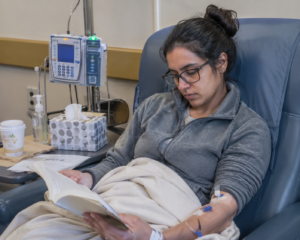
She began disease-modifying therapy immediately — a high-efficacy medication delivered by monthly infusion that works by suppressing the immune cells responsible for attacking myelin. Her neurologist recommended the most aggressive first-line treatment available given the number and location of her lesions. Elena, who had read every study on the subject, agreed without hesitation.
For fourteen months, the treatment worked. No new relapses. No new lesions on her follow-up MRIs. She ran a half marathon in October — something she had been training for before her diagnosis and finished on principle.
Then, in the following spring, the second relapse came.
It arrived without warning on a Wednesday afternoon while she was with a patient. Her vision in her right eye went blurry, then the right side of her face went numb, then her right hand — the hand she used for her work, for her documentation, for everything — stopped responding with the precision she needed.
She excused herself, completed the session through sheer professional discipline, and called her neurologist from the parking lot.
The new MRI showed three new lesions — evidence that her current medication was not providing sufficient protection. Her neurologist recommended switching to a different, more powerful therapy. The new medication required a more intensive monitoring protocol, more frequent bloodwork, more clinic visits, and came with a risk profile that required careful management.
Elena spent a weekend reading everything published about the new medication. On Monday she told her neurologist she was ready to start.
The Cost of Managing a Chronic Disease at 34
Elena is now 34. She has been living with her MS diagnosis for two years. She works four days a week instead of five — a reduction she made after the second relapse, on her neurologist’s recommendation, because fatigue is one of her most persistent symptoms and managing it is part of managing the disease.
The four-day schedule costs her one day’s income every week. Over a year, that is significant.
Marco moved in after the second relapse. This was not entirely because of the MS — they had been together for three years and had talked about living together before the diagnosis — but the timeline was accelerated by the reality that Elena needed someone present on the days when the fatigue was severe enough to make ordinary tasks difficult. She did not ask him to move in for that reason. He offered. She accepted, after two weeks of telling herself she didn’t need help, because she did need help and she was learning to acknowledge that.
“He has never once made me feel like a burden,” she says. “Not once in two years. That is not nothing. That is actually everything.”
The financial cost of her illness has been substantial and ongoing. Her monthly infusions are covered by insurance but the co-pay accumulates. The MRIs — every six months for monitoring — cost $400 out of pocket after insurance. The ophthalmology appointments for monitoring her vision, the physical therapy she does for herself now as a patient rather than a practitioner, the fatigue management specialist she sees quarterly — each of these is a separate cost, a separate appointment, a separate item on a spreadsheet that has become one of the central documents of her life.
She has also spent nearly $3,000 on adaptive equipment and modifications to make her home and work environment more manageable on bad days — ergonomic tools, cooling equipment for heat sensitivity, a second set of everything she needs so she does not have to carry things between home and work when her hands are unreliable.
The total out-of-pocket cost of her MS management in the past two years exceeds $21,000. On a physical therapist’s salary, with a reduced schedule, this has required using savings she had intended for other purposes.
“I grieve the life I thought I was going to have,” Elena says, with the directness of someone who has done enough therapy to say true things plainly. “I grieve it and then I come back to the life I actually have, which is still a good life, which is still a life I am building deliberately and with intention. MS changed the blueprint. It did not stop the construction.”
She returned to running after the second relapse — shorter distances now, with more attention to heat and fatigue, but running. She completed a 10K in April. She cried at the finish line, which she does not consider embarrassing.
She has started speaking at MS awareness events — something she resisted for the first year of her diagnosis because she did not want to be defined by her illness, and which she now does because she has realized that the patients who helped her most in those early months were the ones who spoke honestly about their experience, and she wants to be that for someone else.
She is also, still, a physical therapist. She works with neurological patients. She is, her colleagues say, exceptionally good at it.
“I understand things now that I didn’t understand before,” she says simply. “The fear. The grief. The way your relationship with your own body changes when it stops being something you can trust completely. I understand that now from the inside.” She pauses. “I try to use it.”
If Elena’s story moved you, please consider donating to her fund. Every dollar goes directly to her — helping cover the ongoing costs of managing a chronic neurological disease on a reduced income, the out-of-pocket medical expenses that insurance does not fully absorb, and the adaptive equipment that makes it possible for her to keep doing the work she loves. Elena spent two years learning to ask for help. Your donation is the community answering.
Help Elena by sharing this story
Sharing costs nothing and could bring Elena the support they need.

Be the first to leave a message
Share a word of support, encouragement, or solidarity below.