Amara Was a Nurse Who Recognized Her Own Symptoms. AML Gave Her No Warning.
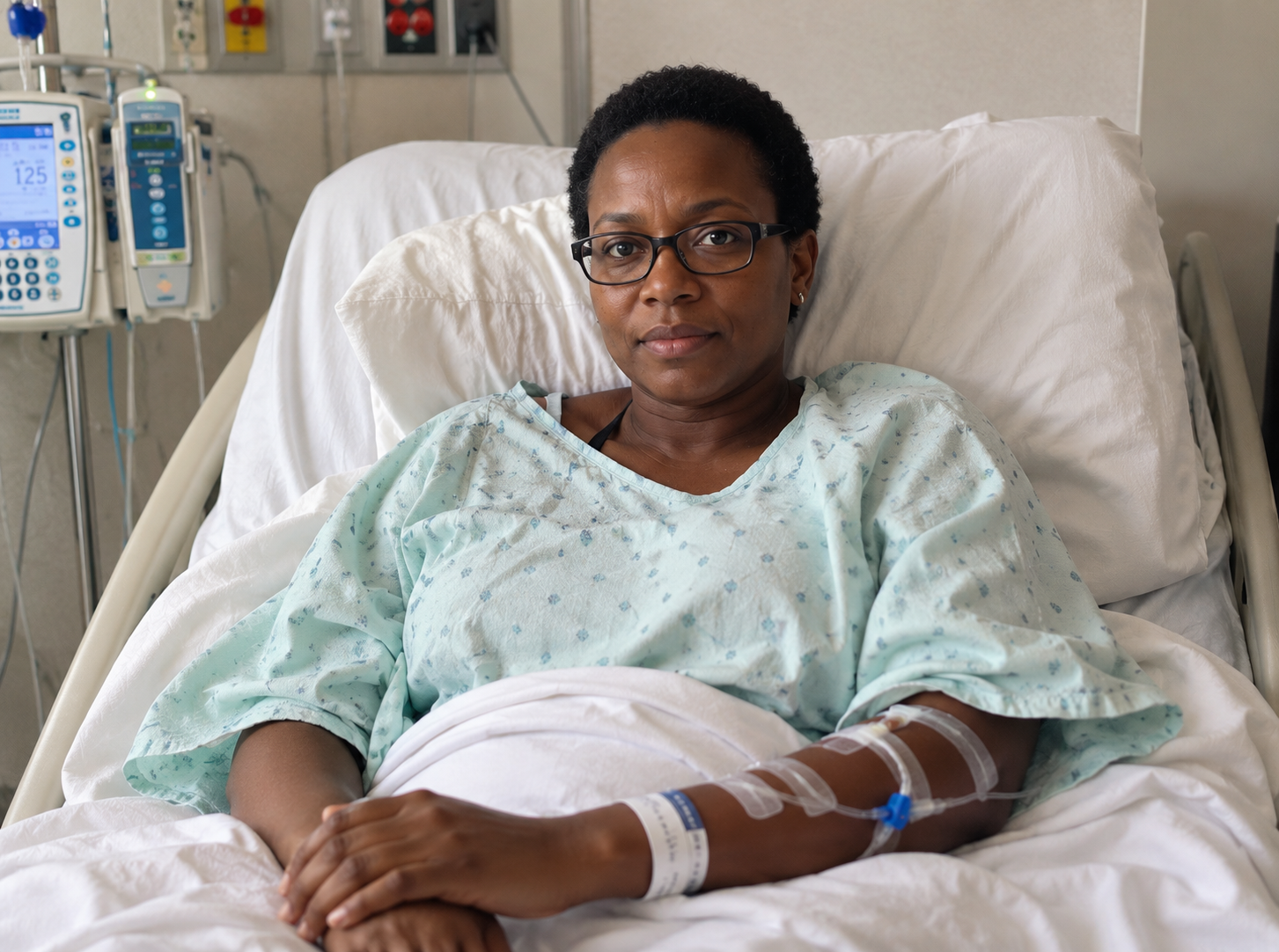
Amara Osei knew what was wrong with her before anyone told her.
She had been a registered nurse for fourteen years, the last eight of them in the oncology unit at a hospital in Atlanta, Georgia. She had sat at the bedsides of hundreds of patients. She had read their labs, explained their diagnoses, held their hands through the terrifying moments that punctuate serious illness. She knew what leukemia looked like from the outside.
In January, she began to recognize it from the inside.
The fatigue was the first sign — not ordinary tiredness, but the specific, bone-deep exhaustion she had watched her patients describe in the same words, year after year. Then the night sweats, soaking through her sheets three nights in a row. Then a bruise on her forearm that she did not remember getting, dark and spreading, the kind of bruise that appears when platelets are not doing their job.
She drew her own blood at work on a Tuesday morning. She ran her own CBC. She looked at the results for a long time before she called her doctor.
Her white blood cell count was 94,000. Normal is between 4,500 and 11,000. She already knew what it meant. She had explained this exact picture to patients more times than she could count.
She called her husband, Kwame, from the hospital parking lot. She told him what she had found and what it likely meant and that she needed him to come get her because she did not trust herself to drive. She was composed on the phone. She was a nurse. Composure was something she had trained for.
She cried for the first time when she saw his car turn into the parking lot.
AML — The Leukemia That Moves Fast
Acute myeloid leukemia is one of the most aggressive blood cancers. Unlike chronic leukemias, which can progress slowly over years, AML can go from first symptoms to life-threatening crisis in a matter of weeks. It originates in the bone marrow, where immature blood cells — called blasts — multiply uncontrollably and crowd out the healthy red blood cells, white blood cells, and platelets the body needs to survive.
AML is not common — approximately 20,000 Americans are diagnosed each year — but it is serious. Without treatment, it is fatal within months. With treatment, outcomes vary significantly depending on the patient’s age, overall health, and the specific genetic subtype of the disease.
Amara’s bone marrow biopsy identified her AML subtype within 48 hours of her hospital admission. Her oncologist told her the genetic profile of her disease was neither the most favorable nor the least — it was intermediate risk, which meant chemotherapy could achieve remission, but the risk of relapse was significant enough that a bone marrow transplant after remission would give her the best chance of long-term survival.
“She explained everything to me in clinical terms,” Amara says. “And then she paused and said — I know you understand all of this medically. How are you doing as a person? Nobody had asked me that yet.” She smiles. “I told her I was terrified. That was the first honest thing I had said since the diagnosis.”
Amara was admitted to the hospital the same day as her diagnosis. She would not go home for thirty-one days.
The Induction That Almost Broke Her
AML induction chemotherapy is administered over seven days — a continuous infusion that runs around the clock, followed by three days of a second drug. It is called 7+3, and it is one of the most intense chemotherapy regimens in oncology. The goal is to kill enough leukemia cells to achieve remission while preserving enough healthy bone marrow function to allow recovery.
Amara knew all of this. Knowing it did not make it easier.
The nausea was manageable with medication. The mouth sores — a common side effect of the chemotherapy — were not. For ten days she could not eat solid food. She communicated with the nurses who cared for her in writing on a notepad because speaking was too painful. She recognized several of the nurses from hospital events and conferences. They were professional and kind and she could see in their eyes that they were being careful with her in the way you are careful with a colleague.
“That was one of the strangest parts,” she says. “Being on the other side. Knowing exactly what they were thinking when they looked at my labs. Knowing what the numbers meant before they came in to explain them. There was no buffer between the information and the fear.”
Kwame came every day. Their two daughters — twelve and eight — came on weekends, masked and gowned, sitting in the visitor chairs doing homework while their mother rested. Amara’s mother flew in from Ghana and stayed for three weeks, sleeping on an air mattress in the corner of the hospital room, praying in Twi under her breath in the hours before dawn.
“My mother has never left my side in a crisis,” Amara says. “She has also never once pretended that something is fine when it isn’t. She prayed for me every night like her life depended on it. That is the most honest form of love I know.”
On day twenty-eight, Amara’s bone marrow biopsy came back. The leukemia was undetectable. Complete remission.
Her oncology team came in together to tell her. One of the nurses — a young woman who had cared for Amara throughout the induction — had tears in her eyes. Amara reached out and held her hand. Old habits.
The Transplant, and the Long Road Home
Remission in AML is necessary but not sufficient. The disease recurs in a significant percentage of patients who achieve remission with chemotherapy alone. A bone marrow transplant — also called a stem cell transplant — gives the patient a new immune system, one that can recognize and attack any remaining leukemia cells.
Finding a donor match took eleven weeks. During those weeks, Amara received consolidation chemotherapy to keep the leukemia at bay while the search continued. She was home for part of this period — a modified version of home, one where she wore a mask indoors, avoided crowds, checked her temperature twice daily, and slept more than she had slept since childhood.
A matched unrelated donor was found through the bone marrow registry. Amara does not know who this person is — registry protocols prevent contact for at least one year post-transplant — but she thinks about them every day. She has written a letter she is not yet allowed to send.
The transplant took place in April. The conditioning regimen — high-dose chemotherapy and radiation designed to destroy Amara’s existing bone marrow before the donor cells are infused — was the hardest thing she has ever experienced. She says this without equivocation, and she has experienced hard things.
She was hospitalized for thirty-eight days around the transplant. Kwame was there every single day. Their daughters made a paper chain — one link for each day until Amara was projected to come home — and removed one link every morning before school.
Amara came home on a Saturday. The paper chain was gone. Her younger daughter had kept the last link and taped it to Amara’s bedroom door.
She is now four months post-transplant. This is the period of highest risk for complications — infection, graft-versus-host disease, relapse — and she is monitored closely, with clinic visits twice a week and blood draws that have become as routine as brushing her teeth. She is not yet cleared to return to work. She does not know when she will be.
She is alive. She is home. Her daughters sleep better.
“I took care of leukemia patients for eight years,” Amara says. “I thought I understood what they were going through. I understood the medicine. I did not understand this — the way it rewrites your sense of time, the way every normal moment becomes something you are aware of having, the way gratitude stops being a feeling and becomes a physical sensation.” She pauses. “I will be a different nurse when I go back. I already know that.”
The financial impact of Amara’s illness has been severe. She has been unable to work since January — nearly eight months. Her nursing salary was the primary income for their family. Kwame works as a high school science teacher and took two weeks of unpaid leave during the transplant hospitalization to be present every day.
The medical costs — the induction hospitalization, the consolidation chemotherapy, the transplant itself and its associated hospitalizations, the twice-weekly clinic visits, the anti-rejection medications she will take for at least a year — have generated out-of-pocket expenses that their insurance has only partially absorbed. The total so far exceeds $26,000, with ongoing monthly costs that show no sign of decreasing in the near term.
Amara’s mother extended her stay from three weeks to five months. She has been cooking, cleaning, caring for the girls after school, and holding the household together with the particular competence of a woman who has held things together before. She will need to return to Ghana eventually. When she does, the gap she leaves will be significant.
Amara does not ask for help easily. It is not in her nature and it is not in her training. Nurses give help. They are not accustomed to needing it.
But she has learned something from eight months on the other side of the bed. She has learned that accepting help with grace is its own form of strength. That letting people show up for you is not weakness — it is what makes community possible.
She is letting people show up.
If Amara’s story moved you, please consider donating to her fund. Every dollar goes directly to her family — helping bridge the income gap, cover ongoing medical costs, and support the household through the months of careful recovery that still lie ahead. Amara spent fourteen years showing up for patients at their most vulnerable. She is one of those patients now. Your donation is how we show up for her.
Help Amara by sharing this story
Sharing costs nothing and could bring Amara the support they need.

Be the first to leave a message
Share a word of support, encouragement, or solidarity below.